Agent.
The problem with a systems map, even if it shows causal chains, is that it’s missing an important deterministic aspect:
Dynamics.
A map is a frozen moment in time. Reality is moving.
All things are under the constant causal pressure of other things. This doesn’t change.
Forces act on everything, always.
Us. Them. The rock in the corner. Constant.
There are ways of adding dynamic modeling to causal maps. One way is to incorporate computationally based agents. They behave according to rules given to them. By way of its own definition, an agent cannot operate outside of its rules.
Agents react to each other. In a swarm, their behavior as a group can be infinitely complex, despite each autonomous agent being governed by even the fewest of rules. As a group, agents can display high intelligence. Slime mold cells are governed by a couple rules each. As a collective, they solve complex problems, such as mazes:
The movement of a wave. A sound of some thing. Everything is a product of some change being caused by forces exerting influence. You are never not under the influence of a force. Nothing ever is.
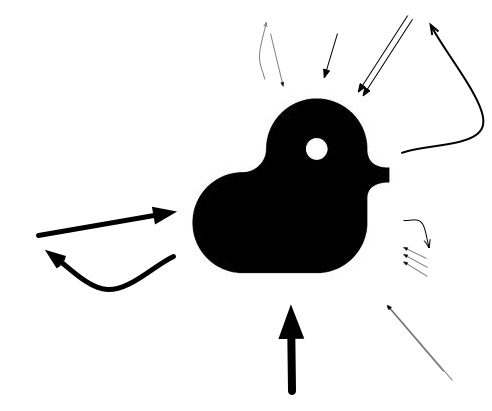
The agent “acts” according to those forces acting on it. To accurately know the agent necessarily means knowing the forces.
Changing the agent means altering the forces. This can be done by a) knowing them and affecting them, b) not knowing them but applying an additional force to the agent and looking for causal effect.
Some forces exert more influence than others.
Identify those strong causal forces, they are leverage points. Altering the leverage points creates causal cascades through the system.
The core of the system is the agent. An agent is an energy balance.
All forces act on the balance, creating a surplus or deficit.
The energies matter. They define the agent.